
Lazos: Connecting Generations
About the project
Date:
Client:
Senac EAD
Services:
UI/UX

Things I Did
I designed and implemented the website structure and layout using Framer’s visual canvas and CMS features.
End-to-End approach, user research, market analysis, wireframes, UI, and interactive prototype.
Context and Problem
The project focuses on the connection between seniors and young people in Murcia (Spain). The local scenario is shaped by three main factors:
Active Aging: Data from INE (Instituto Nacional de Estadística) and the regional council confirm that the Region of Murcia presents one of the most pronounced active aging demographic dynamics in Spain.
Solitude as a Social Phenomenon: According to the Social Observatory of Fundación 'la Caixa' (2020), undesired solitude among seniors in Spain is a public health challenge. The isolation results not only from the lack of contact but from the absence of an active social role, justifying the mentorship proposed by Lazos.
University Context: The sum of students from Universidad de Murcia (UMU), Universidad Católica de Murcia (UCAM), and Erasmus students exceeds 50,000. Pre-career anxiety in this population is documented by counseling services (SOIL) and academic research on university mental health post-2024.
The Need for Mentorship In Murcia, the high volume of students seeking university labor orientation services proves that pre-career insecurity is a real problem. The Lazos application acts precisely where institutional service ends, connecting the student to the city's senior human capital for personalized and streamlined mentorship.
Market Analysis/Benchmarking: Creating something new or improving what already exists?
Although similar applications exist in the market, none has the same goal as Lazos. Competition focuses on language practice, emotional support, and global connections, but fails on the following points:
Excessive monetization and ads: Massive presence of intrusive advertisements and notifications.
Financial barrier: Platforms that require donations, alienating low-income students.
Complex interface: Cluttered screens and excessive buttons that confuse and discourage the elderly audience.
The Lazos Solution: A direct ecosystem, with a clean interface and strictly focused on what retirees and university students need, without excesses.
Methodology and Strategic Adaptations
A mixed and exploratory research method was used. To collect data ethically and viably within the schedule, some strategic adjustments were necessary due to real field challenges:
Access Difficulties: Direct contact attempts with universities, nursing homes, and the Centro Social de Personas Mayores hit bureaucracies, official authorization requests that would take months, and strict data protection restrictions (GDPR).
Respect for Privacy: Cold calls or approaching people in the street were avoided to ensure public comfort and safety. A greater cultural resistance of the Spanish public to deep interactions with strangers on the street was also noted.
Sample Pivot
To mitigate delays, the recruitment strategy was shifted to convenience sampling, prioritizing organic socialization environments:
Senior Audience: Data collection was conducted in person at a bingo hall in Murcia, facilitated by family intermediaries. This approach in a context of trust was essential to ensure the adherence and spontaneity of the participants.
University Audience: The research was disseminated through personal contact networks and expanded to strategic digital communities, such as Erasmus program Facebook groups in Murcia.
Impact on Results: Despite access challenges, the change in strategy generated more valuable insights. The trust established created a safe space for the expression of vulnerabilities and real motivations, resulting in deep and sincere testimonials from a final sample of 10 retirees and 18 students.
Ideation, Wireframes, and Testing
The design process followed clear validation and refinement stages:
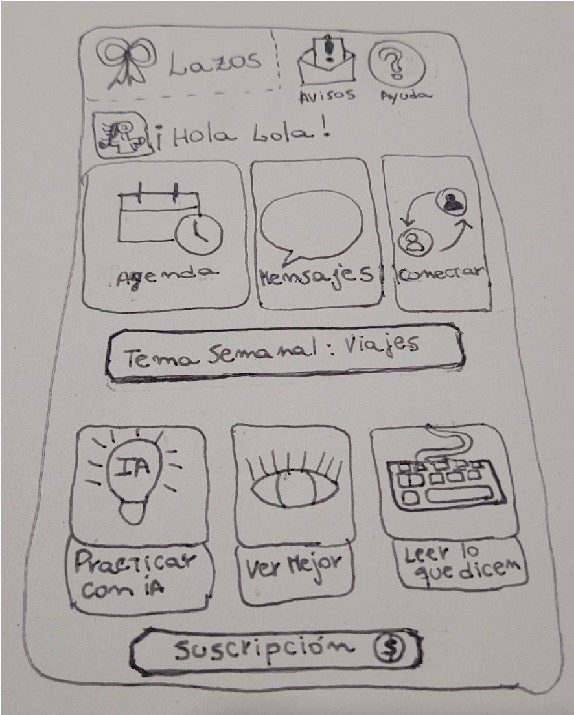
Initial Sketches:
Hand-drawn sketching to structure early concepts.
Local Visual Analysis
Download and study of competing apps in the Spanish/Murcia market.
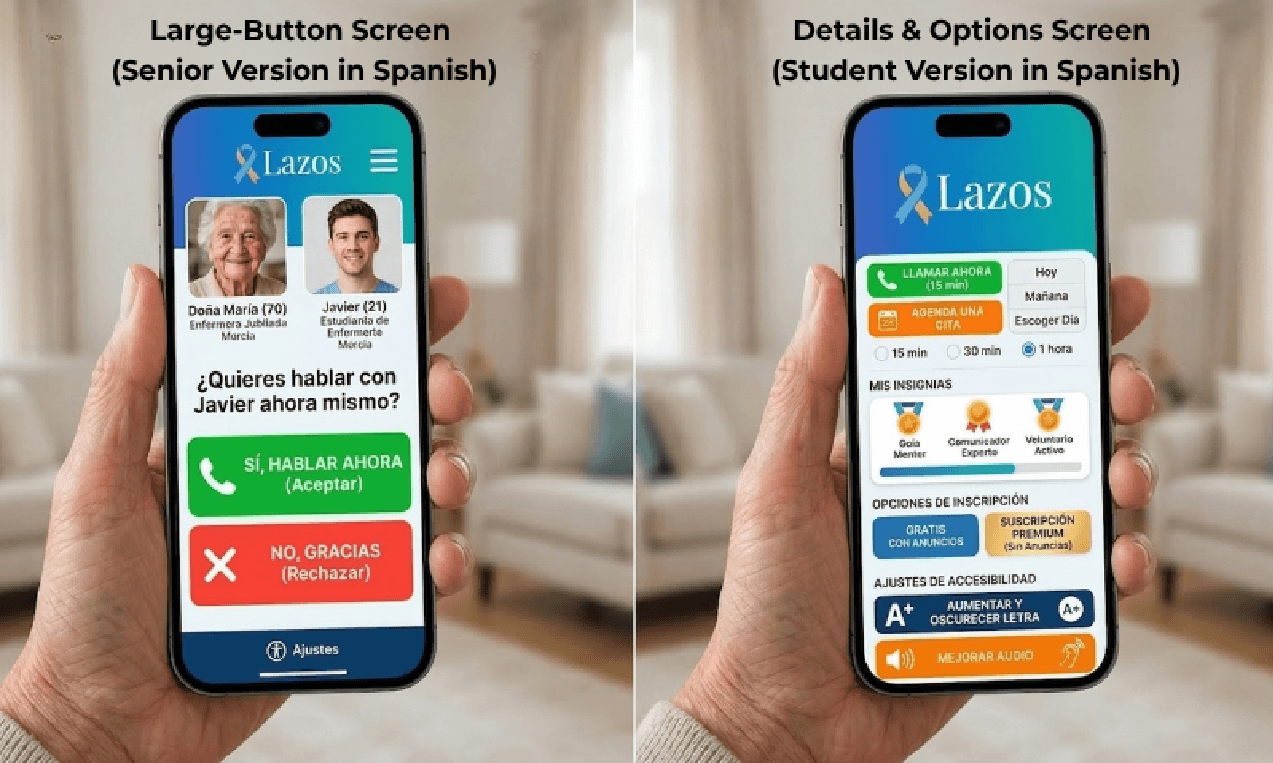
Concept Validation
Generation of two visual interface alternatives for seniors and students to evaluate.
High-Fidelity Prototyping
Based on research feedback, the final prototype was generated in Claude, receiving excellent reception from both audiences.
Usability Test and Preferences
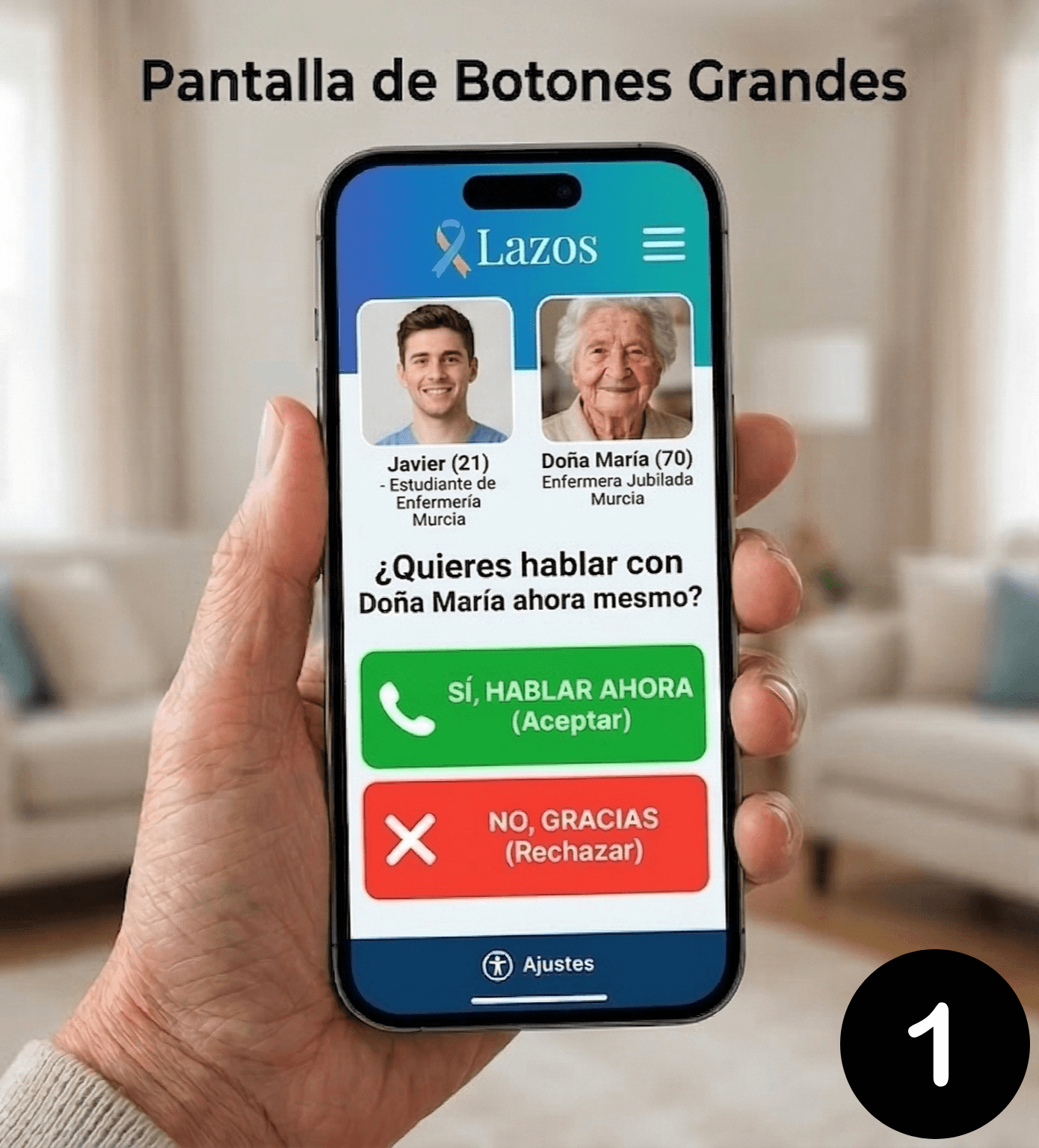
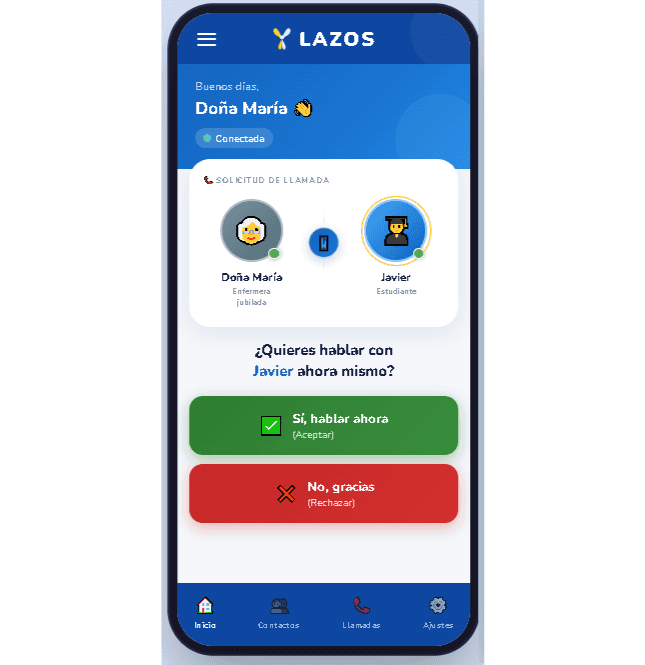
Retirees: There was a clear preference for simple screens with large, well-visible buttons. "Screen 1" won with 98% visual preference among this audience.
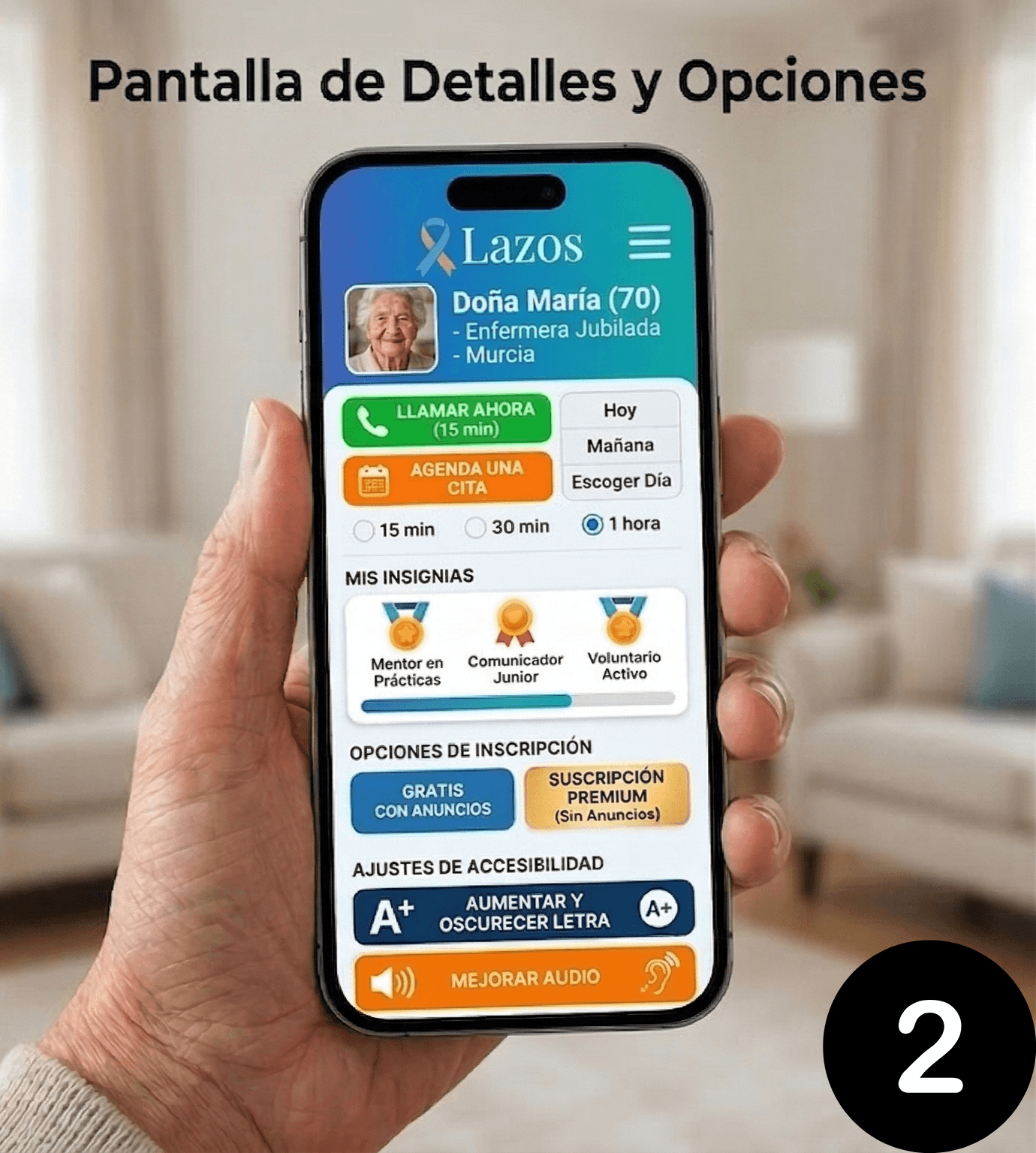
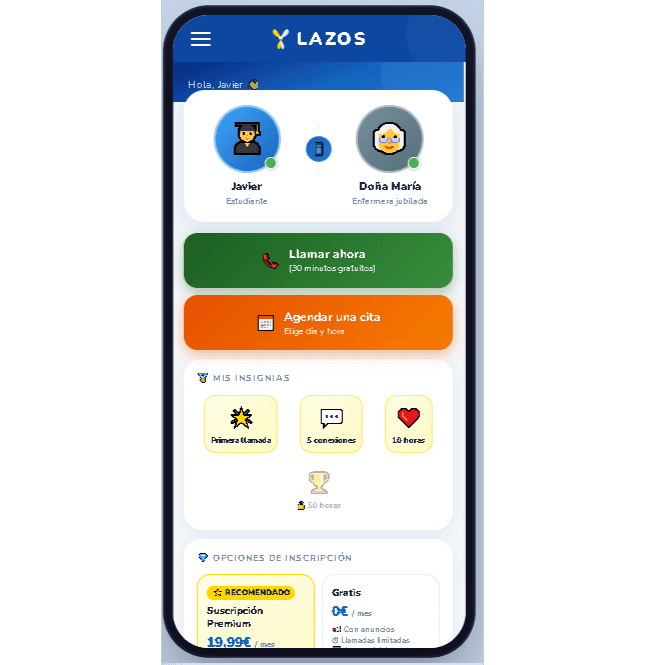
Students: Unlike the seniors, young people demonstrated greater division in choices, presenting a 79% preference for screen with more details.
Final UI and Prototype
Retiree Flow: Emphasis on larger, direct buttons on the home screen.
Student Flow: Display of more options and denser information upon first contact.
Main Results and Insights
Retired Seniors Profile:
Mentorship Model: Exact split in expectations (50% prefer guiding only one student at a time to deepen the bond; the other 50% prefer guiding several young people simultaneously to increase experience exchange).
Accessibility and Routine: Though resistant to cold approaches, they showed great interest in the app, provided use is simple and adaptable to routine.
Highest Perceived Value: The feeling of utility when teaching what they know, sharing life experiences, and telling professional anecdotes.
Additional Requested Features: Demonstrated strong interest in brain games, word searches, news reading, discussion forums, and idea exchange within the app.
Ideal Use Time: Fast sessions of 15 to 30 minutes.
University Students Profile:
Trust Criteria: Requirement that the senior mentor's profile must contain curriculum, professional trajectory, and a photo.
Pragmatic Approach: Total focus on career development, networking, and financial viability.
Restricted Availability: Due to academic and work routines, available time varies from only 1 to 4 hours per week.
Monetization Model: Overwhelming preference (72%) for the free version with ads and limited resources, justified by restricted financial condition ("I am poor"). Subscriptions or payments per session were categorized as secondary options.
Retention Factors: What stops the student from uninstalling the app is the real quality of content, the genuine bonds created, the practical utility of tips, and the possibility of scheduling sessions in advance.
Next Steps
If the project had a broader execution period and fewer bureaucratic limitations, the work would be expanded with the following strategic fronts:
Expansion of the Qualitative Database: Conduct a larger volume of in-depth interviews with both profiles to further refine the empathy maps, overcoming the initial access barriers faced in senior centers and nursing homes.
National Scalability: Test the viability of expanding the app's model to the rest of Spain, adapting the mentorship network to other autonomous communities with demographic dynamics similar to those of Murcia.
Internationalization and Multilingualism: Design the adaptation of the service into other languages, allowing the intergenerational exchange to break through geographical borders and assist in foreign language practice through global mentorships.
Lucas Freire
Professor